Introduction
A parameter sweep is the workhorse of quantitative strategy research: the same backtest kernel evaluated across a grid of configurations, often inside a walk-forward or cross-validation loop that multiplies the evaluation count by another order of magnitude [1]. Sweep throughput therefore sets the pace of the research loop itself, and when a sweep takes an hour on a laptop the conversation reliably turns to hardware—specifically, to GPUs.
This paper measures a prior question: what does the hour consist of?
The typical first implementation of a technical-analysis backtest is not
a tuned engine. It is pandas with
rolling().apply() callbacks for the indicators [2] and an
interpreted Python for loop over bars for the trade logic,
run serially on one core. That profile is not a strawman; it is the
natural expression of the computation in the standard data stack,
and—for weighted moving averages, which have no fused
pandas primitive—rolling().apply() with a
Python-level callback is the idiomatic spelling. Between that starting
point and any accelerator conversation stands a factor we measure
directly: \(297.9\times\) on the same
machine, with the same results, checked to \(10^{-6}\). And because a naive baseline can
flatter any speedup, we co-headline the stricter number: from an
already-vectorized, single-core numpy implementation to the
top rung is still \(13.1\times\).
The design is deliberately controlled. We fix one strategy
kernel—a Hull-moving-average cross with a stateful, bar-by-bar event
loop in which the open position carries across bars—and implement it
five ways: naive pandas (M0), vectorized numpy
(M1) [3],
single-threaded JIT-compiled numba (M2) [4], the same kernel
parallelized across parameter combos with numba prange
threads (M3), and the same kernel parallelized across combos with a
process pool (M4). Every rung is cross-checked to produce identical
per-combo (PnL, trade-count) outputs on all \(80\) combos before its timing counts. The
gate matters because speed comparisons in this space routinely compare
engines that quietly compute different things—different fill
conventions, fee timing, or warm-up handling; here, only speed
differs.
The GPU discussion is then grounded in measurement rather than a slogan. Two facts frame it. First, the feature stage—the weighted-moving-average arithmetic—has a computed intensity of \(10.78\) FLOP/byte under a deliberately GPU-favorable model, so this is not a memory-bound workload that a GPU could not help in principle. Second, a direct time split of the compiled kernel shows that this batchable feature stage is where the CPU actually spends its time: \(99.3\%\), against \(0.7\%\) in the stateful event loop. A GPU could therefore batch essentially all of the compute. The case that it is still not the missing rung rests on leverage, not suitability (Section 5): the exploitable parallelism is only as wide as the \(80\)-combo grid, which the 12-core CPU pool already covers with lanes to spare, and the whole optimized job is \(0.23\) s, so launch and synchronization overheads have nothing to amortize against [5]. The branchy, path-dependent event loop remains a poor SIMT fit [6], but at \(0.7\%\) of the kernel it is a porting nuisance, not the argument.
Throughout, we are explicit about what is and is not claimed. Wall-clock timings are machine-specific; we commit one representative best-of-3 run on disclosed hardware and treat the ordering of the ladder and the equivalence of its rungs—not the exact seconds—as the reproducible findings. The study is one kernel family on one host with synthetic data; the limitations are collected in Section 6.
Contributions.
A controlled five-rung speed ladder for a fixed path-dependent backtest kernel, with an equivalence gate that makes all rungs output-identical on every combo (trade counts exact, PnL to a true absolute \(10^{-6}\)), so the comparison isolates implementation speed from everything else (Section 3).
The measured ladder on disclosed laptop hardware: \(22.7\times\) from
numpyvectorization alone, \(35.3\times\) from single-threadednumba, \(217.6\times\) fromprangethreads, and \(297.9\times\) from a process pool—\(69.92\) s down to \(0.23\) s with zero hardware change, and \(13.1\times\) even from the vectorizednumpyrung (Section 4).An honest decomposition of where the orders of magnitude come from, with the single-core rungs verifiably single-core (BLAS pinned to one thread): vectorization is most of the “free” win, compilation adds a further \(1.55\times\) over
numpy, and orchestration across cores contributes the final \(6.2\times\)–\(8.4\times\); on this host the process pool edges outprangethreads (\(297.9\times\) vs. \(217.6\times\)), the one ordering we flag as least portable (Section 4.3).A reframing of the GPU question from measurement: a measured feature/event-loop time split (\(99.3\%\)/\(0.7\%\) of the compiled kernel) plus a computed arithmetic-intensity bound (\(10.78\) FLOP/byte idealized, \(11.07\) as executed) showing that a GPU could batch the dominant stage—and that what kills the payoff here is the \(80\)-wide parallelism and the \(0.23\) s budget, with the conditions under which a GPU would pay stated explicitly (Section 5).
Related work
The scientific-Python performance stack.
The rungs of our ladder are the standard tools. pandas
supplies the DataFrame and rolling-window machinery that most
practitioners reach for first [2]; its
rolling().apply() executes a Python-level callback per
window, which is the naive profile we time as M0. numpy
provides array programming whose operations execute in compiled loops
[3]; our M1
expresses the weighted moving average as a sliding-window matrix–vector
product and the trade logic as a vectorized reducer. numba
JIT-compiles numerical Python to LLVM machine code [4], including
explicitly parallel loops via prange; it is our M2/M3.
Columnar engines such as Polars [7] attack the same interpreter overhead from
the DataFrame side; we do not benchmark them here because our kernel’s
bottleneck after M1 is the bespoke compiled kernel, not DataFrame
operations.
Vectorized backtesting.
The observation that backtests can be dramatically accelerated by
array programming is embodied in vectorbt [8], which combines numpy
layouts with numba-compiled kernels and reports
orders-of-magnitude gains over event-driven frameworks. Our study is
complementary rather than competing: we could not benchmark vectorbt in
this environment (a Python-version constraint), and more importantly our
aim is not to rank frameworks but to decompose—on one fixed kernel, with
an equivalence gate—where such gains come from: vectorization,
compilation, or orchestration. The ladder shows each layer’s
contribution separately.
Performance models.
The roofline model [9] relates achievable throughput to arithmetic intensity (FLOPs per byte of memory traffic) and is the standard lens for asking whether a workload is compute- or memory-bound; we compute the intensity of our feature stage explicitly and disclose the model behind it. Amdahl’s law [10] bounds the return on parallel resources by the serial fraction of the work, and we invoke it only in that sense; the binding constraint on our sweep is simpler and cruder—finite width: \(80\) independent combos cannot occupy more than \(80\) coarse-grained lanes, however wide the device.
GPU computing.
CUDA established the GPU as a general throughput processor whose model wants tens of thousands of fine-grained threads [11]. Two well-documented failure modes matter for our kernel: control-flow divergence, where threads of a warp serialize on branchy code [6], and host–device data movement, which [5] showed can dominate reported GPU speedups when left unaccounted. Our GPU discussion (Section 5) is an application of these papers to a measured workload profile, not a new measurement of GPU hardware.
Why sweeps are large at all.
The demand for throughput comes from validation practice: walk-forward and cross-validation protocols re-run the sweep per fold [1]. The same literature warns that search breadth inflates selection bias; we return to this in Section 6, because a faster engine is an amplifier for multiple testing, not a substitute for validation discipline.
One kernel, five implementations
The strategy kernel
Data.
Performance of this kernel is size-bound, not value-bound—the work per bar is fixed by the window lengths, not by the prices—so we use a synthetic close series: geometric Brownian motion with zero log-drift, per-bar log-return volatility \(0.0008\), initial price \(30{,}000\), length \(150{,}000\) bars, seed \(42\). Using synthetic data makes the benchmark self-contained and the equivalence fingerprint deterministic.
Features.
All indicators are built from the linearly weighted moving average \[\begin{equation} \mathrm{WMA}_p(x)_t \;=\; \frac{\sum_{j=1}^{p} j\, x_{t-p+j}}{\sum_{j=1}^{p} j}, \label{eq:wma} \end{equation}\] undefined (NaN) for \(t < p\). With \(r(\cdot)\) denoting rounding to the nearest integer, the Hull moving average of length \(L\) and its HMA3 variant (windows floored at \(1\); \(q = L/2\)) are \[\begin{align} \mathrm{HMA}_L(x) \;&=\; \mathrm{WMA}_{r(\sqrt{L})}\!\big(2\,\mathrm{WMA}_{r(L/2)}(x) - \mathrm{WMA}_{L}(x)\big), \label{eq:hma}\\ \mathrm{HMA}^{3}_L(x) \;&=\; \mathrm{WMA}_{r(q)}\!\big(3\,\mathrm{WMA}_{r(q/3)}(x) - \mathrm{WMA}_{r(q/2)}(x) - \mathrm{WMA}_{r(q)}(x)\big), \label{eq:hma3} \end{align}\] which issue \(7\) WMA passes per parameter combo, \(6\) of them distinct: since \(q = L/2\), the inner HMA3 window \(r(q)\) coincides with the HMA half-window \(r(L/2)\), so the WMA of the raw series at that window is computed twice, identically in every rung (the duplication is part of the fixed kernel and leaves the equivalence untouched). Section 3.5 counts the arithmetic both ways.
Event loop.
The trading rule is a stateful cross. On each bar \(t\) where both features are defined, the direction is \(d_t = +1\) if \(\mathrm{HMA}_L(x)_t < \mathrm{HMA}^{3}_L(x)_t\) and \(-1\) otherwise. The first valid bar opens a position in direction \(d_t\) at the close; whenever \(d_t\) flips, the open position is closed at the current close and a new one opened in the new direction. Each round trip books \[\begin{equation} \text{pnl} \;=\; \pm\,\frac{c_{\text{exit}} - c_{\text{entry}}}{c_{\text{entry}}} \times 100 \;-\; \phi, \qquad \phi = 0.09, \label{eq:pnl} \end{equation}\] the signed return in percentage points minus a \(0.09\%\) round-trip fee (matching a production fee model). The per-combo output is the pair (total PnL, trade count). The loop is genuinely path-dependent: the position state carries from bar to bar, so bars cannot be processed independently within a combo. This is the property that blocks naive vectorization of the trade logic—though, as Section 3.5 measures, it is not where the compiled kernel spends its time.
Parameter grid.
The sweep runs \(80\) combos: integer HMA lengths spread uniformly over \([6, 200]\), in ascending order (cheap windows first, expensive last—a detail that will matter for load balancing in Section 4.3).
The five rungs
Each rung computes exactly the sweep above.
M0 pandas (the naive profile). Each WMA is
rolling(p).apply()with a dot-product callback executed per window in Python; the event loop is an interpreted Pythonforover all bars. One core.M1 numpy (vectorized). Each WMA is a
sliding_window_viewmatrix–vector product. The event loop is replaced by an equivalent vectorized reducer: direction flips are located withdiff/flatnonzero, and all trades are booked in one closed-form array expression. One core, verified: BLAS is pinned to a single thread (Section 3.4).M2 numba (compiled). Both the WMA and the bar-by-bar event loop are
@njit-compiled; the loop retains its stateful form—no vectorization trick is needed once the loop is machine code. One thread.M3 numba-prange (threads). M2’s kernel unchanged, with the combo loop parallelized by
numba prangeacross \(12\) threads. Parallelism is across combos only; each combo’s event loop stays serial.M4 mp+numba (processes). M2’s kernel unchanged, with combos distributed over a
ProcessPoolExecutorof \(12\) workers, handed out one combo at a time (chunk size \(1\) at this grid size), i.e. dynamically load-balanced.
M1 is the one rung whose code shape differs (a reducer instead of a loop); the equivalence gate below is what licenses calling it the same computation.
The equivalence gate
Before any timing is reported, every rung’s per-combo (PnL, trade-count) pairs are compared against the M1 reference on all \(80\) combos—the pandas baseline included, since it too is measured in full. Trade counts must match exactly; PnL must agree within an absolute tolerance of \(10^{-6}\) percentage points, with the comparison’s relative-tolerance term set to zero, so the bound is genuinely absolute (the rungs in fact agree far more tightly). In the committed run all checks pass. The result is a ladder in which the only thing that varies is speed: any speedup that survives the gate cannot come from computing something cheaper.
The fingerprint of the first grid point (\(L = 6\)) is PnL \(-5165.58\) percentage points over \(57{,}029\) trades. We record it as a correctness fingerprint, not tradable alpha—see Section 4.4.
Timing methodology and hardware
All timings are wall-clock (perf_counter), best of \(3\) repeats. The minimum is a deliberate
choice of estimator: it is the noise-minimized estimate of the
achievable steady-state time, and it discards the cold first pass (page
cache, JIT load) by construction. JIT compilation is excluded throughout
(each numba kernel is warmed on a short prefix before its
timer starts, with on-disk caching enabled; pool workers are warmed with
dummy tasks that trigger compilation before the timed map). The M0
baseline is measured in full—all \(80\) combos, best-of-3, like every other
rung—and its outputs enter the equivalence gate on all \(80\) combos. (A development version of this
benchmark extrapolated M0 from \(5\)
uniformly sampled combos; that estimate, \(70.20\) s, is within half a percent of the
full measurement, \(69.92\) s, but the
committed number is measured, not estimated.)
The host is an Apple M2 Max (12 CPU cores, a mix of performance and
efficiency cores), macOS 26.3 (arm64), Python 3.14.6, numpy
2.4.3 built against Apple’s Accelerate BLAS, numba 0.64.0
with \(12\) threads, and \(12\) pool workers. BLAS is pinned to a
single thread at import (OMP_NUM_THREADS and its siblings
set to \(1\)): M1’s sliding-window
product is a GEMV that Accelerate would otherwise multithread, silently
smuggling parallelism into the “vectorization alone” rung. With the pin,
M0–M2 are verifiably single-core and the
vectorization/compilation/orchestration decomposition of Section 4.2 is honest. This machine has no
NVIDIA GPU; no CUDA is used or required anywhere in the study, and the
GPU section is analytical. We commit one representative run of this
configuration as results.json; every number quoted in this
paper is mechanically checked against that file.
Where the kernel spends its time, and its arithmetic intensity
The measured feature/loop split.
The compiled kernel factors exactly into the WMA feature stage and
the event loop, so we time the feature stage alone over the same grid
and take the ratio: the features account for \(99.3\%\) of the single-thread
numba kernel’s wall time, the stateful event loop for \(0.7\%\). This measurement matters twice. It
locates the engine’s work in the batchable arithmetic, not in the serial
loop—a fact the GPU discussion must respect (Section 5)—and it
explains why compiling the loop pays modestly while parallelizing across
combos pays largely: the loop was never the bulk of the compiled
kernel’s time.
A computed, GPU-favorable intensity bound.
For the roofline framing we model the feature stage’s arithmetic intensity: each \(\mathrm{WMA}_p\) over \(n\) bars costs \(2p\) FLOPs per bar (\(p\) multiplies, \(p\) adds) and, with perfect sliding reuse, streams its length-\(n\) float64 input once (\(8\) bytes per bar). Counting the \(6\) distinct WMAs per combo over \(80\) combos at \(n = 150{,}000\) (\(480\) distinct passes), the sweep’s feature stage totals \(6.21\) GFLOP against \(576\) MB of traffic: \[\begin{equation} \text{AI} \;=\; \frac{\sum_{\text{combos}}\sum_{\text{windows } p} 2\,p\,n} {\sum_{\text{combos}} 6 \cdot 8n} \;=\; 10.78 \ \text{FLOP/byte}; \label{eq:ai} \end{equation}\] counting the \(7\) passes the kernel actually issues (\(560\) in the sweep, the duplicated window included) gives \(11.07\). We stress that the model is a deliberately GPU-favorable hybrid: it pairs naive-recompute FLOPs (\(2p\) per bar, no sliding-sum or prefix tricks) with best-case streamed traffic (\(8\) bytes per bar, each input read once), while the as-executed inner loop re-reads \(p\) values per bar (mostly from cache), so real memory traffic is higher and the true intensity lower. \(10.78\) is a computed bound, not a measurement. The point of reporting it is the opposite of a memory-bound story: even generously idealized, the ratio is far above one, so the feature math is exactly the kind of work a GPU could batch. The honest GPU argument must therefore rest elsewhere (Section 5).
Results
The ladder
| Rung | Implementation | Wall (s) | Speedup | Combos/s | Parallelism |
|---|---|---|---|---|---|
| M0 | pandas rolling().apply() +
Python loop |
\(69.92\) | \(1.0\times\) | \(1.1\) | 1 core |
| M1 | numpy sliding-window + vectorized reducer | \(3.07\) | \(22.7\times\) | \(26.0\) | 1 core |
| M2 | numba njit WMA +
njit event loop |
\(1.98\) | \(35.3\times\) | \(40.4\) | 1 thread |
| M3 | M2 kernel, prange across
combos |
\(0.32\) | \(217.6\times\) | \(248.9\) | 12 threads |
| M4 | M2 kernel, process pool across combos | \(0.23\) | \(297.9\times\) | \(340.9\) | 12 processes |
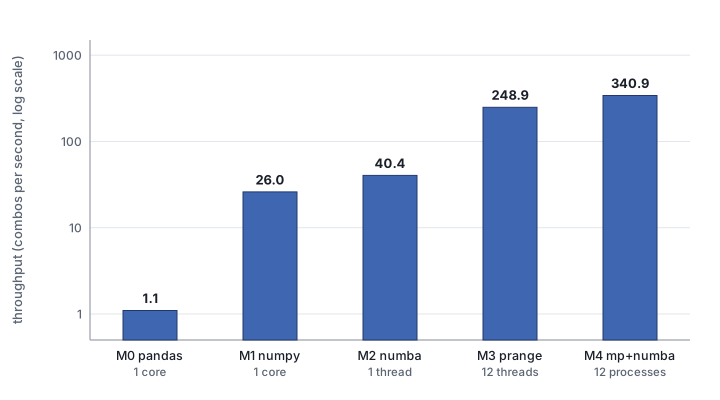
Table 1 and Figure 1 are the
study. The naive profile needs \(69.92\) s for the \(80\)-combo sweep—\(0.87\) s per combo—and the top rung needs
\(0.23\) s, or \(2.9\) ms per combo: a \(297.9\times\) end-to-end speedup on
identical hardware with output-identical results. And because that
headline stands on a deliberately naive baseline, we state the stricter
one alongside it: from the competently vectorized M1—a single-core
numpy implementation many would already call fast—to the
top rung is \(13.1\times\). For scale:
a \(10{,}000\)-combo overnight-sized
search at the M0 rate is a \(2.4\)-hour
job; at the M4 rate it is a coffee break. Nothing about the strategy,
the data, or the results changed between the two rows.
Where the orders of magnitude come from
The ladder decomposes the gain into three distinct mechanisms. The decomposition is honest by construction: BLAS is pinned to one thread (Section 3.4), so no hidden parallelism leaks into the single-core rungs.
Vectorization is most of the “free” win (\(22.7\times\)).
Moving from rolling().apply() and an interpreted bar
loop to numpy—no compiler, no parallelism, one pinned
core—already buys \(22.7\times\). The
mechanism is the removal of per-window and per-bar Python interpreter
dispatch: M0 crosses the C/Python boundary once per window per WMA (plus
once per bar in the trade loop), while M1 crosses it once per array
operation. This rung requires re-expressing the event loop as a
vectorized reducer, which is possible for this rule (flips can be
located, then trades booked in closed form) but is exactly the step that
does not generalize to richer path dependence—which is why M2
matters.
Compilation adds \(1.55\times\) over numpy (\(35.3\times\) total) and removes the shape constraint.
numba compiles the loop form of the kernel: the
WMA becomes a fused multiply–add loop with no temporaries, and the event
loop runs as machine code in its natural stateful shape. The speed gain
over M1 is a modest \(1.55\times\)—M1’s
inner product already runs in compiled code, and M1 pays mainly for
materialized temporaries and strided window reads—but the structural
gain is larger than the factor suggests: M2 no longer requires the trade
logic to be expressible as array algebra. Any path-dependent rule that
fits in a loop now runs at compiled speed.
Orchestration supplies the final \(6.2\times\)–\(8.4\times\).
The remaining rungs change no kernel code at all; they only schedule
the \(80\) independent combos across
the 12 cores: \(217.6\times\) with
prange threads, \(297.9\times\) with a process pool. This is
the cheapest order of magnitude in the ladder—a dozen lines of
orchestration around an unchanged kernel.
Threads versus processes
Against the single-thread M2, the thread rung scales \(6.2\times\) on 12 threads (\(51\%\) parallel efficiency) and the process
rung \(8.4\times\) (\(70\%\)); M4 beats M3 by \(1.37\times\). Sub-linear scaling is
expected—the combo costs are skewed (window length, and hence cost,
grows along the grid), the host mixes performance and efficiency cores,
and the sweep is short enough that end-of-sweep straggling is visible.
The direction of the M3/M4 gap is consistent with scheduling: the
process pool hands out combos one at a time (chunk size \(1\)), dynamically balancing the skewed
costs, while prange partitions the combo range statically,
so a thread that draws the expensive tail windows finishes last. We flag
this ordering as the least portable claim in the paper: it is one run on
one heterogeneous-core host, we did not instrument the schedules, and on
other hosts (or other grid orderings) threads may well win—threads share
the feature arrays, while processes pay serialization and per-worker
warm-up that our timing deliberately excludes. Our tests assert only
that both parallel rungs beat the single thread, not their mutual
order.
What the equivalence gate certifies—and what it does not
All equivalence checks pass in the committed run: every rung, the pandas baseline included, matches M1 on all \(80\) combos (trade counts exactly; PnL to an absolute \(10^{-6}\) with zero relative tolerance). The committed fingerprint of the first grid point (\(L = 6\)) is a PnL of \(-5165.58\) percentage points over \(57{,}029\) trades.
We stress what this number is: a correctness fingerprint, not tradable alpha. On driftless GBM noise the shortest-window cross flips roughly every \(2.6\) bars, and \(57{,}029\) round trips at a \(0.09\)-point fee cost \(5{,}132.61\) points; the gross PnL before fees is \(-32.97\) points, i.e. near zero, exactly as a moving-average cross on a martingale should gross. The strategy loses its fee bill, as it must; the fingerprint’s value is that five independent implementations agree on it to \(10^{-6}\). No performance claim about HMA crosses is made or implied anywhere in this paper.
Why a GPU is not the missing rung
The ladder ends at the CPU, and the reader may ask where the GPU rung is. The honest answer must begin with two concessions, one modeled and one measured. At a computed \(10.78\) FLOP/byte (\(11.07\) as executed) the feature stage is not memory-bound, so the lazy dismissal—“backtests just stream data, GPUs can’t help”—is wrong for this kernel [9]. More pointedly, the measured time split of Section 3.5 shows the compiled kernel spends \(99.3\%\) of its time in exactly this batchable WMA arithmetic: all \(480\) distinct window convolutions of the sweep could in principle be evaluated in a few large batched launches [11]. A familiar version of the no-GPU argument claims that the serial event loop is where an optimized backtest spends its remaining time; our measurement refutes that—the loop is \(0.7\%\) of the kernel. A GPU could batch essentially all of the compute. The case that it is still not the missing rung is about leverage, not suitability, and it rests on two structural facts.
(a) The exploitable parallelism is \(80\) combos wide.
The sweep exposes one unit of coarse-grained parallelism per combo; within a combo the feature passes are few and the event loop is a serial dependency chain. A GPU is a throughput machine that wants tens of thousands of resident threads to hide latency [11]; mapped one combo per thread the device would idle, and even the batched-GEMV formulation of the feature stage offers only \(80\) columns of independent work at a time. This is not an Amdahl serial-fraction effect [10]—almost everything here parallelizes—it is finite width: \(80\) tasks cannot occupy more than \(80\) coarse lanes, however wide the device. Nor is the CPU pool the binding constraint: at \(51\)–\(70\%\) parallel efficiency the work is finite and skewed, and more lanes—CPU or GPU alike—mostly buy idle lanes.
(b) The budget left to beat is \(0.23\) s.
The input is small—\(150{,}000\) float64 bars is \(1.2\) MB—so bulk bandwidth is not the issue; the issue is that the end-to-end time a GPU implementation must beat is a quarter of a second. On this host’s unified memory the transfer term is minor, which moves kernel-launch and synchronization overhead to the foreground; on discrete-GPU CUDA systems host–device transfer joins it, the accounting [5] showed routinely erases claimed GPU advantages on small kernels. Fixed overheads that are noise against the naive rung’s \(69.92\) s are structural against \(0.23\) s: there is almost nothing left to amortize them over.
The event-loop residue.
The stateful loop remains a poor SIMT fit—branchy, divergent, position carried bar to bar [6]—so a full-device port must either leave it on the CPU (adding a device–host synchronization to every sweep) or accept divergent scalar code on the device. But at \(0.7\%\) of the kernel this is a porting cost, not a performance argument, and we deliberately do not lean on it.
Platform note and the honest carve-out.
On this host (Apple silicon) the would-be GPU path is MLX or PyTorch-MPS, not CUDA, and either requires rewriting the hot path for the device. We state the boundary of the claim plainly: for this workload shape—a modest combo grid, one series, path-dependent per-combo state, a quarter-second optimized budget—the missing rungs between \(69.92\) s and \(0.23\) s were engine and orchestration, and hardware was constant. Workloads shaped differently can absolutely justify a GPU: sweeps of \(10^{5}\)–\(10^{6}\) configurations, cross-sectional feature pipelines over many assets, stateless or batchable PnL rules, or ML training inside the loop are width- or compute-rich in exactly the way this kernel is not [11]. And we do not close the door here either: recasting this sweep as one large batched tensor program—every combo’s features as columns of a single device-resident matrix computation, with the thin loop stage reformulated or left on the host—is a genuinely promising direction that deserves its own controlled measurement, not a dismissal from a laptop (Section 7).
Limitations
One host, wall-clock numbers.
Every timing in this paper is a wall-clock measurement on one Apple M2 Max laptop; none of the constants (\(69.92\) s, \(297.9\times\), \(51\)–\(70\%\) efficiency) should be expected to transfer to other machines, and the M3-vs-M4 ordering in particular is host-specific (Section 4.3). We commit one representative best-of-3 run and disclose the host, the BLAS backend and its thread pinning, and the library versions. What is deterministic and checked by the released tests is the equivalence of the rungs and the coarse ladder ordering (M0 \(<\) M1 \(<\) M2 \(<\) parallel rungs in combos/s), not the seconds.
One kernel family, synthetic data.
The kernel is a single-asset HMA/HMA3 cross with seven WMA passes per combo and a two-state event loop, on GBM noise. Kernels with heavier per-bar state (order books, multi-asset portfolios, intrabar fill models) have different profiles—in particular the M1 rung’s closed-form reducer does not exist for most of them, making the M0\(\to\)M2 compiled-loop path the relevant one, and the \(99.3\%\)/\(0.7\%\) feature/loop split of Section 3.5 would shift toward the loop. The data being synthetic is by design (perf is size-bound and the fingerprint deterministic), but it also means no claim here touches real-market behavior.
The baseline is deliberately naive.
M0 is the profile of a first implementation, not of an expert
pandas user; anyone who replaces
rolling().apply() with array expressions has effectively
moved to M1. The baseline is nonetheless measured in full and
equivalence-checked on every combo—its naivety is in its code shape, not
in any estimation—and the \(13.1\times\) M1\(\to\)M4 figure is the reader’s guard
against strawman amplification.
The GPU analysis is analytical, not measured.
We did not implement the batched MLX/MPS reformulation; Section 5 combines a measured CPU time split with a modeled, deliberately GPU-favorable intensity bound, and its conclusion is scoped to this workload shape on this class of budget. The batched “big-matrix” GPU direction remains untested here and is marked as future work, not refuted.
vectorbt and other engines are not measured.
Our environment’s Python version predates available vectorbt builds, so its published gains [8] are discussed as prior art only; the ladder does not rank frameworks.
Speed amplifies multiple testing.
A \(297.9\times\) faster sweep evaluates \(297.9\times\) more configurations per unit of researcher patience, and the expected maximum of a search grows with its breadth [1]. Throughput is an instrument; without deflation and out-of-sample discipline it mostly manufactures overfitting faster. This paper prices the instrument, not the research program.
Conclusion
We built a five-rung speed ladder for one fixed, path-dependent backtest kernel and gated every rung on output equivalence over every combo, so that exactly one thing varies: implementation. On a 12-core laptop the ladder spans \(69.92\) s to \(0.23\) s—\(297.9\times\) from the naive profile, and still \(13.1\times\) from a competently vectorized single-core baseline—with \(22.7\times\) from vectorization alone, \(35.3\times\) from a single compiled thread, and the rest from scheduling \(80\) independent combos across cores (\(217.6\times\) threads, \(297.9\times\) processes; the process pool’s dynamic balancing wins on this host, an ordering we do not claim travels). The GPU question, reframed by measurement: \(99.3\%\) of the compiled kernel is batchable feature arithmetic a GPU could genuinely run—the payoff dies on the \(80\)-wide parallelism and the quarter-second budget, not on any unsuitability of the math. We therefore do not write the GPU off: recasting the sweep as one large batched tensor program over a much wider combo grid, or for a feedback-free kernel family, is a separate and promising direction that deserves a dedicated measurement. The bottleneck in mass parameter search of this shape is the engine and the orchestration; the hardware was never the constraint. For the practitioner the recipe is three steps long: vectorize what vectorizes, JIT-compile the loop that does not, and parallelize across the sweep—and only then, if the workload’s width and shape have genuinely outgrown the CPU, price an accelerator against the profile you measured.
Reproducibility.
A single command regenerates results.json:
python scripts/run_all.py, whose default
--repeats 3 matches the committed run. It measures all five
rungs in full and re-runs the equivalence gate on every combo, while
--quick runs a small smoke version and writes
results_quick.json, never clobbering the canonical file.
scripts/check_paper_numbers.py verifies that every number
quoted in this paper matches the committed
results.json at its printed precision (and that each quoted
constant literally appears, with word-boundary matching, in the LaTeX
source); tests/ re-runs a reduced ladder and asserts the
deterministic invariants—equivalence, ladder ordering, and the
arithmetic-intensity bound—without asserting machine-specific wall
times. The committed results.json is one representative
best-of-3 run on the disclosed host (Apple M2 Max, 12 cores,
numba 0.64.0, numpy 2.4.3 on Accelerate pinned
to one BLAS thread, Python 3.14.6, seed \(42\)).